
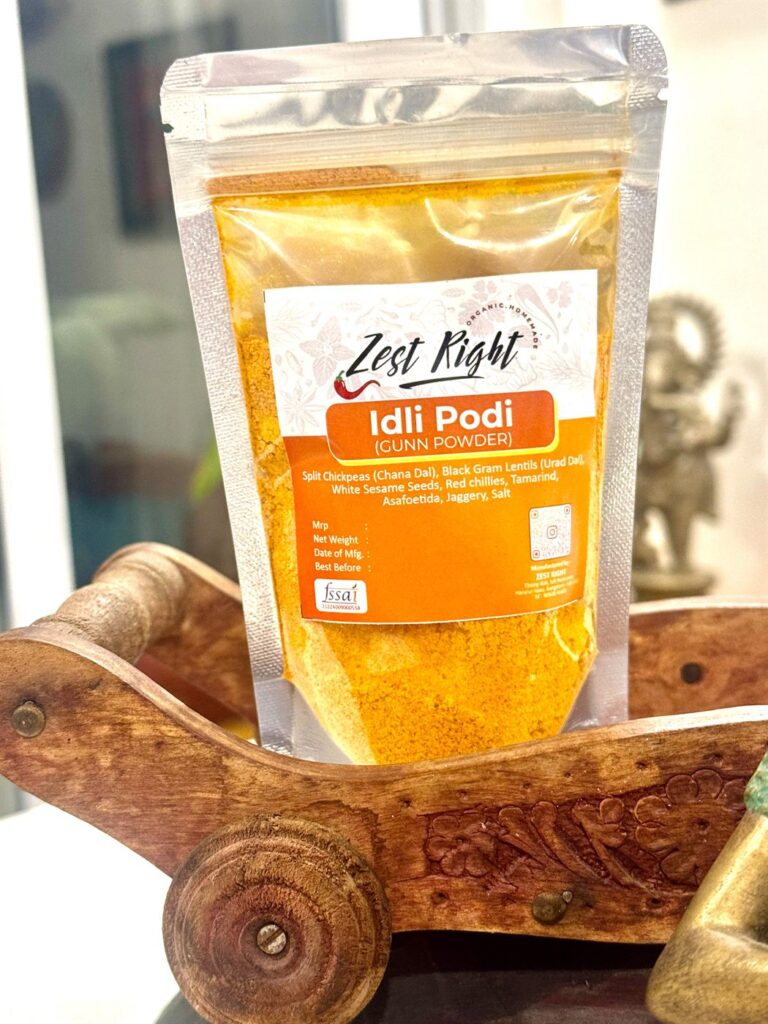
If you did not grow up with them, the South Indian podi shelf can be confusing. Several jars, all brownish-red, all smelling faintly wonderful, and no obvious clue about which goes where.
Here is the short version: a podi is a dry spice blend, usually built on roasted lentils and spices. Some are eaten as they are. Others are the base of a whole dish.
Idli podi – the one you eat straight away
Often called milagai podi or simply gunpowder. This is a ready-to-eat blend.
Mix one to two teaspoons with sesame oil or ghee and serve as a dip alongside idlis, dosas or uttapams. It is also excellent sprinkled over hot rice, vegetables or snacks.
Because it is made from roasted lentils and spices, it brings plant-based protein and dietary fibre along with the flavour.
Sambar powder – the base of a full meal
This one is not eaten as-is; it is the backbone of sambar.
- Cook toor dal until soft and mash it well.
- Cook your vegetables – drumstick, pumpkin, carrot, radish, brinjal or okra – until tender.
- Add tamarind extract, the cooked vegetables and two to three teaspoons of sambar powder to a pan, and simmer briefly.
- Stir in the dal, adjust the consistency with water and simmer for 8 to 10 minutes.
- Finish with a tempering of mustard seeds, curry leaves, dried red chillies and asafoetida in ghee or oil.
The same blend also works in kootu, vegetable curries, lentil dishes and poriyal.
Rasam powder – lighter, sharper, peppery
Rasam is thinner than sambar and built around pepper, cumin and tamarind. Rasam powder is what gives it that clean, warming sharpness that makes it the standard remedy in South Indian homes when someone is under the weather.
Paruppu podi – the everyday one
A gentler lentil-based podi, mixed with hot rice and a spoon of ghee. This is comfort food, and often the first solid flavour a South Indian child learns to love. There is a garlic version too, if you want more punch.
How much should you use?
- Idli podi: 1 to 2 teaspoons per serving, mixed with oil or ghee.
- Sambar powder: 2 to 3 teaspoons for a family-sized pot.
- Paruppu podi: 1 to 2 teaspoons over hot rice.
Start low. A freshly ground podi is considerably stronger than a mass-produced one, and you can always add more.
Storing them properly
Keep podis in an airtight container away from moisture and direct sunlight, and always use a dry spoon. Moisture is what ruins a good podi – not time.